
Proven crisis management strategies to strengthen your brand
A practical crisis management guide covering the lifecycle approach, crisis team roles, adaptable response strategies, and post-crisis reviews that build long-term brand resilience.
Published
Apr 6, 2026
Reading Time
12 min read
Author
Almost Impossible
TL;DR: Most organisations lack a documented crisis plan, risking brand damage during routine risks. Building a lifecycle approach with preparation, response, and recovery phases enhances resilience. Effective teams are small, clear, and practiced regularly, with adaptable strategies tailored to each crisis type.
A strong crisis response isn’t written during the crisis. It’s built in advance, tested under pressure, and executed with calm clarity when it matters most.
Most corporate leaders assume their organisation is better prepared for a crisis than it actually is. That gap between confidence and reality is where brands get destroyed. Many organisations still confuse confidence with readiness. In one recent crisis-readiness study, close to 70% of surveyed organisations lacked an identified cross-functional crisis response team or pre-selected external advisers, yet crises are not rare events reserved for headline-grabbing disasters. They are routine business risks: a supplier failure, a social media firestorm, a data breach, a key executive scandal. The leaders who navigate these moments with their brand intact are not lucky. They are prepared. This guide walks you through the core phases, team structures, adaptive strategies, and post-crisis learning loops that separate resilient organisations from those that simply react and hope.
Key Takeaways
| Point | Details |
|---|---|
| Preparation is vital | Establishing clear roles, plans, and process before a crisis greatly improves outcomes. |
| Communication matters most | Timely, empathetic communication reduces damage and protects trust during any crisis. |
| Strategies must adapt | Different crisis types require different approaches: flexibility and context-aware decisions are key. |
| Learning closes the loop | Continuous post-crisis reviews and implemented lessons make your organisation stronger over time. |
Understanding the core phases of crisis management
With the scale of unpreparedness in mind, let’s clarify what robust crisis management actually entails.
Crisis management is not a single moment of action. It is a lifecycle. Understanding that lifecycle is the first step towards building genuine organisational resilience. The three core phases are pre-crisis preparation, active crisis response, and post-crisis recovery. Each demands a distinct mindset and a specific set of actions.
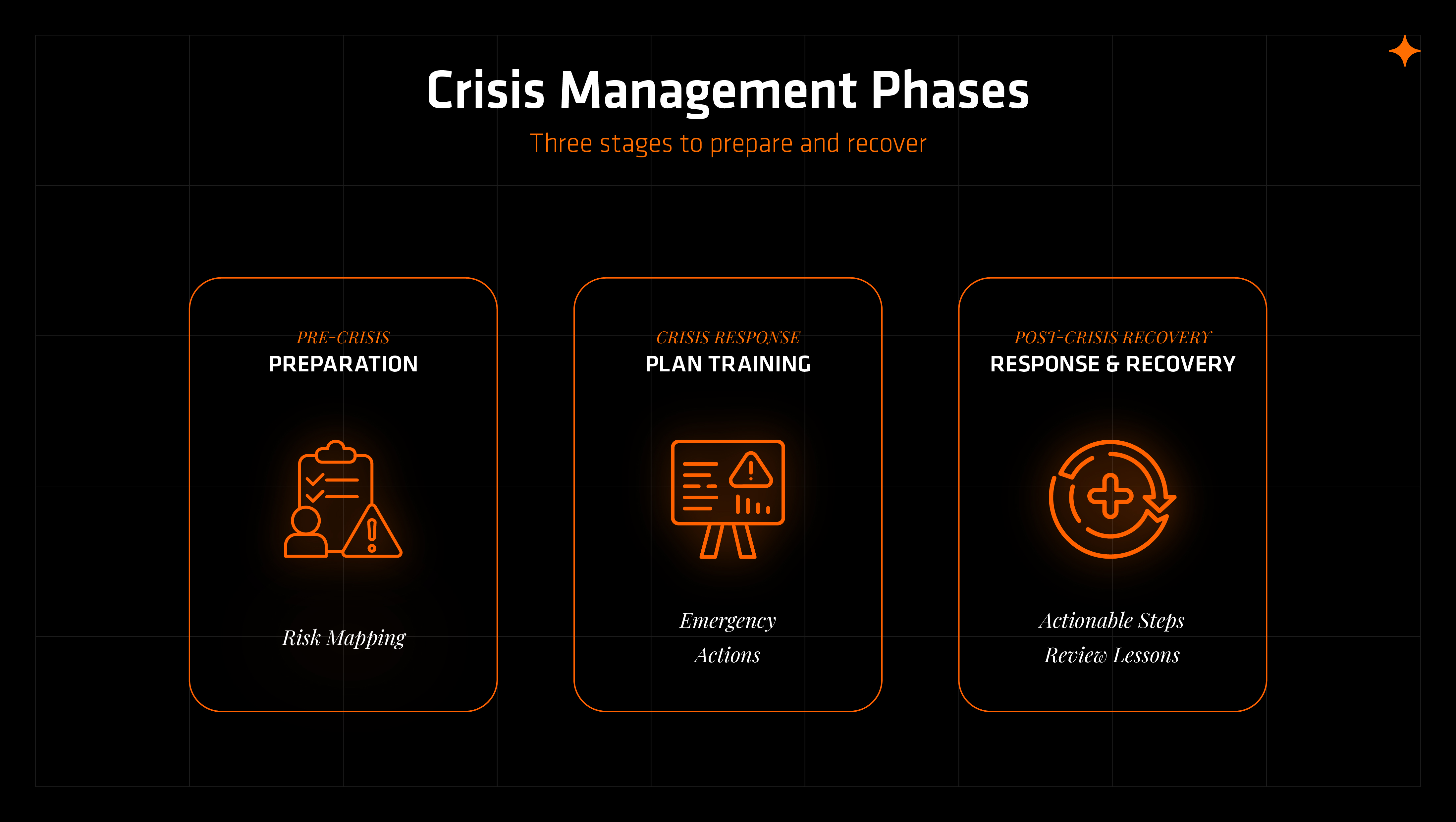
Pre-crisis is where the real competitive advantage is built. This phase covers risk assessment, scenario planning, team formation, communication protocol development, and regular simulation exercises. Most organisations either skip this phase entirely or treat it as a one-time documentation exercise. That is a costly mistake.
Crisis response is the execution phase. Speed, clarity, and coordinated communication define success here. Leaders must activate pre-assigned roles, follow established protocols, and communicate with both internal and external stakeholders quickly and honestly. Improvisation at this stage is expensive.
Post-crisis recovery is often underestimated. This phase involves restoring operations, rebuilding stakeholder trust, evaluating what worked, and implementing improvements. It is also where organisations that treat crisis management seriously pull ahead of competitors who treat it as a checkbox.
Here is how the three phases break down in practice:
| Phase | Core activities | Common failure points |
|---|---|---|
| Pre-crisis | Risk mapping, plan development, team training | Plans exist but are never tested |
| Crisis response | Activation, communication, decision-making | Slow response, unclear authority |
| Post-crisis recovery | Debrief, stakeholder repair, plan updates | Lessons identified but not implemented |
The lifecycle applies equally to minor incidents and major catastrophes. A well-structured crisis plan treats a social media complaint with the same disciplined process as a product recall, scaled appropriately. That consistency builds organisational muscle memory.
Key tasks by phase include:
- Pre-crisis: Identify risk scenarios, assign team roles, draft communication templates, run tabletop exercises
- Response: Activate the crisis team, issue initial holding statements, coordinate operations and legal review
- Recovery: Conduct structured debriefs, publish stakeholder updates, revise the plan based on findings
Building your crisis management team: Roles and responsibilities
Once the crisis phases are understood, effective response depends on your team’s structure and clarity.
A crisis plan is only as strong as the people executing it. Ambiguity about who owns what decision during a high-pressure event is one of the fastest ways to turn a manageable situation into a full-scale failure. Standard team roles include a crisis leader, communications lead, operations manager, legal advisor, and HR representative. Each role carries specific authority and accountability.
Here is how a typical team structure compares to an optimised one:
| Role | Typical setup | Optimised setup |
|---|---|---|
| Crisis Leader | Senior executive, often unavailable | Designated with a clear deputy |
| Communications Lead | PR manager reacts to media | Proactive spokesperson with pre-approved messaging |
| Operations Manager | Coordinates internally only | Bridges internal and external logistics |
| Legal Advisor | Consulted after decisions | Embedded in real-time decision loop |
| HR Representative | Handles employee queries reactively | Proactively manages internal morale and messaging |
The difference between these two columns is not headcount. It is clarity, preparation, and succession rules. When your primary crisis leader is unreachable, does everyone know who steps in? If the answer requires a meeting to determine, your structure needs work.
For additional context on how leading organisations structure their crisis teams, reviewing team structure best practices reveals a consistent pattern: the most effective teams are small, empowered, and rehearsed.
Key structural principles to build in:
- Assign primary and backup leads for every role
- Establish clear escalation thresholds so decisions happen at the right level
- Define communication channels in advance, including backups if primary channels fail
- Document decision authority explicitly so no one waits for permission during a crisis
Pro Tip: Rotate simulation leadership among your team leads quarterly. When different people practice leading the response, you build real depth across the organisation rather than dependence on one person. You can see how real-world crisis team examples demonstrate this principle in action.
Essential crisis management strategies for leaders
A highly functioning crisis team needs robust strategies. Here is what separates best-in-class organisations from those who merely improvise.

Key crisis strategies consistently include proactive planning, scenario-based training, timely and empathetic communication, technology integration, and decentralised decision-making. Together, these elements create an organisation that can move fast without losing coherence.
Here is a practical readiness checklist for leaders:
- Conduct a formal risk assessment covering at least five distinct crisis scenarios
- Develop and document a crisis communication protocol with pre-approved message templates
- Assign and train all crisis team roles, including backups
- Run at least two simulation exercises per year, one of which is unannounced
- Integrate a centralised crisis management platform for real-time alerts and coordination
- Establish a stakeholder communication schedule for the first 24, 48, and 72 hours of a crisis
- Review and update the crisis plan after every significant incident or simulation
The pitfalls that derail even well-resourced teams are usually behavioural, not structural. Silence in the early hours of a crisis is interpreted as guilt or incompetence. Denial of an obvious problem destroys credibility faster than the crisis itself. Slow communication gives external narratives time to form without your input.
Recent BCI research found that almost 65% of organisations activated emergency communications plans between one and five times in the previous year, which means the majority of leaders have now experienced what it feels like to need a plan under pressure. The ones who had practiced came out ahead.
Pro Tip: Technology can close the gap between a crisis plan on paper and a crisis team in action. Centralised platforms that push real-time alerts, coordinate task assignments, and log decisions create accountability and speed simultaneously. Explore crisis scenario applications to see how this works in practice.
Leadership messaging during a crisis must combine empathy and accountability. Acknowledge the impact on those affected before explaining what the organisation is doing about it. That sequence matters enormously to stakeholders and to the crisis playbook strategies that consistently produce trust recovery.
Adapting strategies to crisis type and context
No single playbook fits every crisis. Tailoring your approach to the specific threat is essential.
A cyberattack demands a fundamentally different response than a product recall or a natural disaster. Crisis types differ in their duration, logistics demands, and the trust dynamics they activate. Treating them identically is a strategic error.
Here is how strategy shifts by crisis type:
- Cyber crisis: Speed is critical. Contain the breach, notify affected parties within legal timeframes, and avoid speculating about cause until forensics are complete. Centralised decision-making works best here.
- Physical crisis (facility, supply chain, safety): Operational coordination dominates. Decentralised decision-making with clear local authority prevents bottlenecks when headquarters is remote from the incident.
- Reputation crisis: Narrative control is the priority. Empathy, transparency, and a credible corrective action plan must come fast. Silence or defensiveness accelerates damage.
- Multi-factor crisis: When two or more crisis types converge, the temptation is to manage them separately. Resist it. A unified command structure with clear priority sequencing prevents resource conflicts.
The contrast between Johnson and Johnson’s Tylenol recall response in 1982 and Volkswagen’s emissions scandal response in 2015 illustrates this perfectly. J&J moved fast, accepted accountability, and prioritised public safety. VW delayed, minimised, and ultimately faced far greater financial and reputational consequences. Corporate case studies consistently show that the response strategy matters as much as the underlying incident.
“Speed over perfection in communications. Empathy and accountability are non-negotiable.”
Leadership adaptability and stakeholder trust are the two variables that matter most in emerging crisis types, particularly those involving digital platforms, AI-related incidents, or supply chain complexity. Organisations that invest in adaptive crisis solutions before a crisis hits are the ones that protect brand equity when it counts.
Leveraging post-crisis reviews for continuous improvement
Once immediate danger has passed, the final competitive advantage lies in what you learn and implement for the future.
Post-crisis reviews are where most organisations leave value on the table. The debrief happens, the report gets written, and then the recommendations sit in a shared drive untouched. Too often, post-crisis recommendations are documented but never assigned, tracked or implemented, according to recent research. That is a staggering waste of hard-won experience.
Here is the implementation gap in context:
| Review outcome | Typical rate | Best-in-class rate |
|---|---|---|
| Recommendations documented | 85% | 95% |
| Recommendations assigned to owners | 40% | 90% |
| Recommendations implemented within 90 days | 28% | 75% |
| Plan updated based on findings | 35% | 85% |
Closing this gap requires process, not just intention. Here is a structured approach:
- Schedule the debrief within 72 hours of crisis resolution while details are fresh
- Use a structured format: what happened, what worked, what failed, what must change
- Assign every recommendation to a named owner with a specific deadline
- Build a follow-up review at 30 and 90 days to check implementation progress
- Report outcomes to senior leadership to maintain accountability and organisational learning
The organisations that treat crisis evaluation findings as strategic assets rather than administrative obligations are the ones that get measurably better at crisis management over time. That compounding improvement is a genuine competitive advantage.
Why most crisis management frameworks fail in practice
Even with great frameworks, the reality is most organisations fall short where it matters most.
Here is the uncomfortable truth we have observed repeatedly: the failure point is almost never the plan itself. It is the gap between documentation and culture. A crisis plan that lives in a PDF and gets reviewed once a year is not a crisis plan. It is a liability shield.
The organisations that actually perform well under pressure have made crisis readiness a cultural norm, not a compliance exercise. They practice. They debrief honestly. They reward people who surface bad news early rather than punishing them for it. Leadership values substance over optics, which means they are willing to say difficult things quickly rather than waiting for the perfect message.
There is also a dimension most frameworks ignore entirely: the reputational contagion risk from peer organisations. Speed and candor outperform perfection when another company’s crisis threatens to spill onto your brand by association. Waiting to see how it plays out is not a strategy. It is a gamble.
Pro Tip: Ask your team this question in your next simulation: “If our closest competitor’s crisis became ours tomorrow, what would we do in the first two hours?” The answer reveals exactly where your preparation has gaps. Review lessons from brand crises to stress-test your assumptions against real scenarios.
The most resilient organisations we have worked with share one trait: they are genuinely curious about failure, including other people’s failures. That curiosity, combined with honest practice, is what transforms a framework into a capability.
Enhance your ORGANISATION’S crisis resilience with expert support
If you are ready to move from theory to practical resilience, dedicated support can transform preparation into lasting confidence.
Building genuine crisis readiness requires more than a template. It requires tested frameworks, scenario-based training, and an honest assessment of where your organisation is most exposed. At Almost Impossible, we work with forward-thinking brands to design, simulate, and stress-test crisis management programmes that hold up under real pressure. Our crisis response playbook gives you a structured starting point built from real-world experience. Explore our client results to see how we have helped organisations build resilience that lasts, or see our solutions to understand the full scope of what we offer. When you are ready to start the conversation, contact our team and let’s assess where you stand.
FAQs
What are the three main phases of crisis management?
The three core phases are pre-crisis preparation, crisis response, and post-crisis recovery. Each phase needs different actions, owners, and success metrics, from readiness and decision-making speed to recovery and trust rebuild.
Why is proactive crisis planning more effective than a reactive approach?
Proactive planning builds trust and organisational readiness before pressure hits. Reactive responses tend to be slower, more inconsistent, and more likely to amplify damage in the moments when confidence matters most.
What roles should be on a crisis management team?
A strong team includes a crisis leader, communications lead, operations owner, legal, and HR, each with a named backup to ensure continuity. The goal is clear decision rights, fast approvals, and one consistent narrative across every channel.
How can we ensure post-crisis lessons are actually implemented?
Assign every recommendation to a named owner with a deadline, then schedule 30- and 90-day follow-ups to confirm what changed. The difference between learning organisations and repeating organisations is simple: accountability that survives once the crisis fades.
Recommended
What's Next?

Start a Project
Have a challenging brief? We thrive on the impossible. Let's build something world-class together.
Get in touch
Join the Team
Obsessed with details? We're always looking for world-class designers and engineers.
View openingsFollow the Journey
See what we're building, reading, and learning. Connect with us on LinkedIn.
Connect on LinkedIn