
TL;DR: Genuine storytelling is far more memorable and impactful than facts alone, enhancing long-term brand loyalty. Effective brand stories focus on the customer as the hero, emphasising authentic tension and meaningful resolution. Not all brands need stories; prioritise honesty and value propositions, especially for immediate responses or inauthentic campaigns.
Storytelling is not “nice to have”. It’s the shortest route to meaning, and meaning is what people remember, repeat, and stay loyal to.
Every brand wants to be remembered. But in a market as competitive and fast-moving as the UAE, being memorable takes more than a sharp logo or a catchy tagline. It takes a story that lands emotionally and sticks. Stories are 22x more memorable than facts alone, which means the brands that invest in genuine narrative are playing a fundamentally different game. This article breaks down how to evaluate great brand storytelling, highlights campaigns that set the standard, and gives you a clear framework for deciding when and how to use storytelling for your own brand.
Key Takeaways
| Point | Details |
|---|---|
| Narrative structure matters | Following the setup, tension, and resolution arc makes stories more engaging and effective. |
| Emotional impact boosts recall | Stories are 22 times more memorable than facts, driving brand loyalty and engagement. |
| Authenticity drives results | Genuine, relevant stories outperform inauthentic attempts and avoid damaging trust. |
| Storytelling is not always best | Brands should assess if storytelling fits their goals, sometimes direct strategies work better. |
How to evaluate great brand storytelling
Not every brand story is worth telling. Before you green-light a campaign built on narrative, you need a clear set of criteria to judge whether the story actually works. The most reliable framework is the brand narrative arc, which adapts the classic three-act structure for marketing: Setup, Tension, and Resolution.
The Setup introduces the protagonist and the world they live in. The Tension presents a problem or conflict that creates stakes. The Resolution shows how the brand helps resolve that conflict in a meaningful way. When all three acts are present and well-executed, audiences feel the story rather than just hear it.
But structure alone is not enough. Here are the core criteria you should use to evaluate any brand story:
- Authenticity: Does the story reflect something genuinely true about the brand’s values or origin?
- Relevance: Does the audience see themselves in the protagonist or the conflict?
- Narrative tension: Is there a real problem that creates emotional stakes?
- Resolution: Does the brand’s role in solving the problem feel earned, not forced?
- Emotional resonance: Does the story trigger a specific feeling, not just a vague sense of inspiration?
“The best brand stories don’t make the brand the hero. They make the customer the hero and position the brand as the guide.”
Pro Tip: Before producing any campaign, write the story in two sentences: who is the protagonist, and what do they want that they cannot yet have? If you cannot answer that clearly, the story is not ready.
It is also worth knowing when storytelling is not the right tool. If your goal is direct response, like driving immediate sign-ups or flash sales, a narrative arc can actually slow conversion. Storytelling earns its place when you are building long-term loyalty, not when you need someone to click right now. Keep that distinction sharp.
Brand storytelling examples: Standout campaigns
With clear criteria in mind, here are real-world brand storytelling examples that show these principles in action.
Nike: You can’t stop us (2020)
Nike’s split-screen film stitched together footage of athletes across different sports, bodies, and backgrounds to tell a single unified story about resilience. The protagonist was every athlete who had ever been told they could not. The tension was the global disruption of sport during the pandemic. The resolution was collective defiance.
- Protagonist: Athletes worldwide
- Stakes: Loss of sport, identity, and community
- Conflict: External forces shutting down what drives them
- Resolution: Unity and the refusal to stop
- Emotional impact: Pride, solidarity, determination
Dove: Real beauty (ongoing)
Dove challenged the beauty industry’s own standards by making real women the protagonists of a story about self-worth. The tension was the gap between manufactured beauty ideals and lived reality. The resolution was radical acceptance. This campaign has run for over two decades because the story is genuinely true to the brand’s positioning.
As the research shows, stories are 22x more memorable than facts, and these campaigns prove why. You can also see how this principle plays out in our clients case studies, where emotional narrative drives measurable brand outcomes.
Pro Tip: When adapting a global campaign for a Dubai, the UAE or MENA audience, do not just translate the copy. Translate the emotional context. What creates tension for a consumer in London may feel irrelevant in Dubai. Anchor the conflict in local realities: family expectations, career ambition, or community belonging.
“Campaigns that win in the Gulf earn trust first. The story has to feel like it belongs here, not like it was shipped in.”
Comparison: What sets these stories apart
After looking at standout campaigns, it’s essential to compare them directly and identify what truly sets compelling storytelling apart.
The data is clear: stories are 22x more memorable than facts. But not all stories perform equally. Here is a direct comparison of the campaigns covered above.
| Brand | Narrative arc | Emotional hook | Primary channel | Reported outcomes |
|---|---|---|---|---|
| Nike | Athletes vs. adversity | Solidarity and defiance | Video/social | 8.7M YouTube shares in 24 hours |
| Dove | Women vs. beauty standards | Self-worth and acceptance | TV/digital | 30% brand trust increase over 5 years |
Looking at these campaigns side by side, several patterns emerge:
- The protagonist is never the brand. In every case, the brand steps back and lets a human story lead.
- The tension is culturally specific. Nike’s adversity resonates globally. Dove’s aspiration resonates regionally. Both are precise, not generic.
- Resolution is earned, not announced. None of these brands simply say they are helpful. They demonstrate it through the story’s outcome.
- Channel choice amplifies the emotion. Video carries emotional weight that static formats cannot match for narrative-driven campaigns.
For UAE-based brands, the replicable pattern is this: identify a tension that your audience genuinely lives with, build a protagonist who mirrors your customer, and let the brand’s product or service be the turning point, not the headline.
How to choose the right storytelling approach for your brand
Having compared notable campaigns, now let’s review how to decide if and how to apply storytelling for your brand.
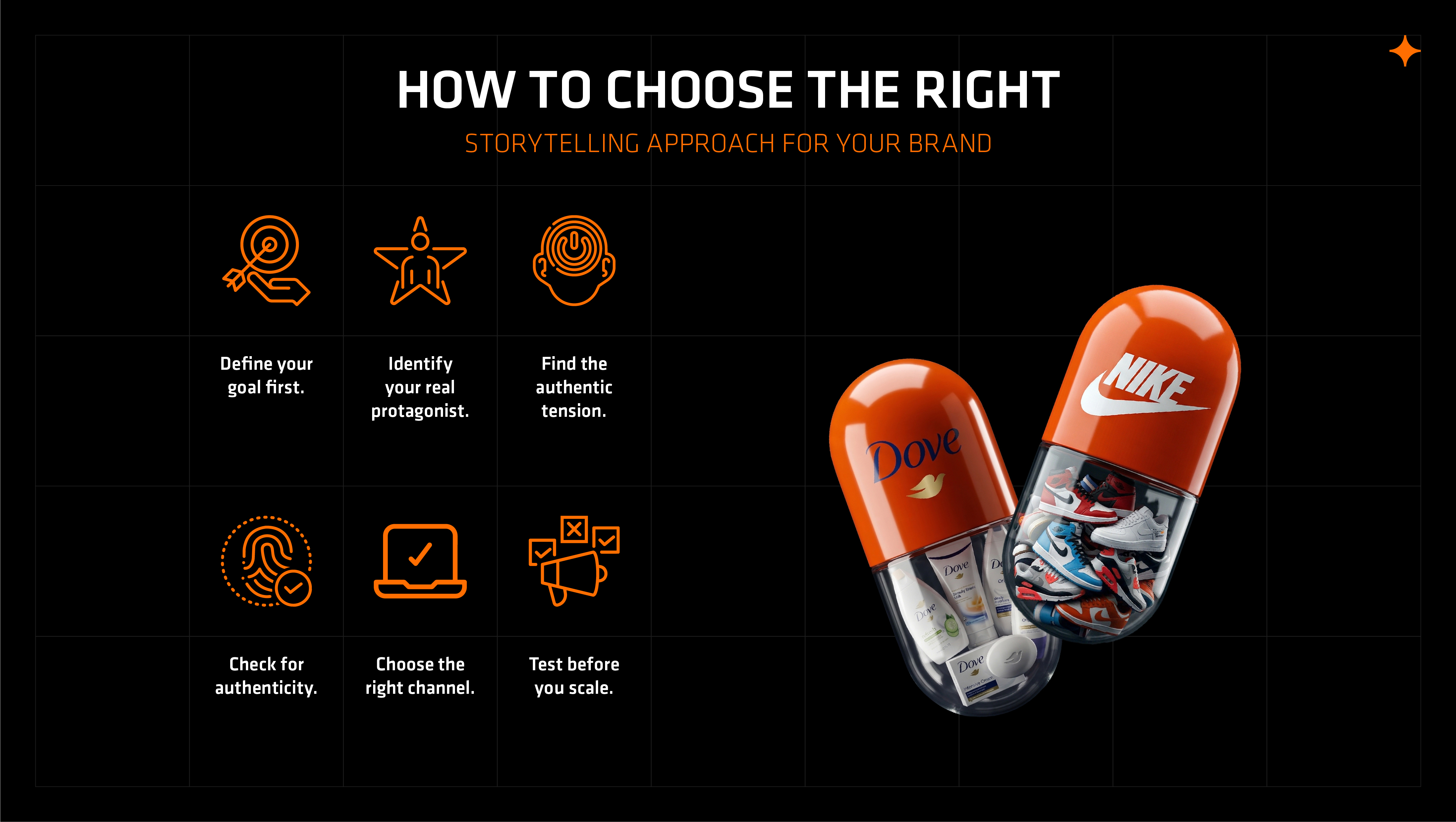
Not every brand is ready for a narrative-driven campaign. Here is a step-by-step process to assess your readiness and choose the right approach.
- Define your goal first. Are you building long-term brand equity or driving short-term conversions? Storytelling serves the former far better than the latter.
- Identify your real protagonist. Who is your customer, and what do they genuinely want? If you cannot answer this without using marketing language, you need more audience research before you write a single word of story.
- Find the authentic tension. What real problem does your brand solve? Not the feature, not the product benefit, but the human frustration or aspiration underneath it.
- Check for authenticity. Does this story connect to something genuinely true about your brand? Forced stories are easy to spot, and audiences in the UAE’s connected market will call them out fast.
- Choose the right channel. Long-form narrative works on video. Shorter emotional beats work on social. Match the depth of your story to the format.
- Test before you scale. Run a smaller version of the campaign with a defined audience segment and measure emotional response, not just clicks.
As storytelling edge cases research highlights, inauthenticity is the biggest risk. A story that feels manufactured does more damage to brand trust than no story at all.
Warning signs your story is not working:
- The brand is the hero, not the customer
- The tension feels manufactured or exaggerated
- The resolution requires the audience to already trust you
- The story could belong to any brand in your category
Pro Tip: Use social listening tools to find the language your customers already use when describing their problems. The best brand stories are written in the audience’s own words, not the brand’s.
A new perspective: Why not all brands need a story
Here is a view that does not get enough airtime in marketing circles: some brands are better off without a story, at least right now.
The pressure to have a brand narrative has become its own kind of noise. When every brand is telling a story, the ones that cut through are often the ones that simply make a clear, honest offer. In a city like Dubai, where consumers are sophisticated and time-poor, sometimes directness is the differentiator.
Forced storytelling is also a trust risk. Storytelling is not always the best strategy when the underlying story is not genuine. We have seen brands in the region invest heavily in emotional campaigns that audiences rejected because the story did not match the product experience. The gap between the narrative and reality is where brand credibility goes to die.
The honest lesson is this: earn the right to tell a story. Build a product or service that genuinely changes something for your customer. Then the story writes itself. Until then, a clear value proposition will outperform a manufactured narrative every time. Story fatigue is real, and audiences recognise it faster than most brand managers expect.
Take your brand storytelling to the next level
If this article has sparked ideas for how your brand can build deeper emotional connections, the next step is seeing what’s possible in practice.
At Almost Impossible, we have built campaigns that turn genuine brand truths into stories audiences remember and act on. From the Cards of Hope campaign, which used sustainable design to carry a human message, to the Bullet Train VR project, which put audiences inside a story rather than in front of it, our work is built on the same principles covered in this article. Explore our brand storytelling work to see how narrative-driven strategy translates into real brand outcomes. When you’re ready to build something that sticks, we are ready to help.
FAQs
What are the core elements of a successful brand story?
A successful brand story has a clear protagonist, stakes, tension, and resolution, structured to mirror the classic three-act narrative. The brand narrative arc framework provides a practical structure: Setup, Tension, and Resolution, each designed to evoke real emotional responses rather than passive awareness.
Are brand stories really more memorable than simple facts?
Yes. Stories are 22x more memorable than facts alone, making narrative one of the most powerful tools available for brand recall and long-term loyalty. This is why the most enduring campaigns lead with human conflict, not product features.
When should a brand not use storytelling?
Avoid storytelling when your primary goal is direct response or when the story lacks genuine authenticity. As research on storytelling edge cases confirms, forced or inauthentic stories can actively damage brand credibility, especially in markets where consumers are highly connected and quick to share negative sentiment.
How can UAE-based brands adapt global storytelling frameworks?
Dubai-based brands should anchor the emotional tension of their stories in local realities, such as family dynamics, career ambition, or community identity, rather than simply translating global campaigns. Testing with a regional audience segment before scaling ensures the story resonates with the emotional context that drives loyalty in the Gulf market.
Recommended
What's Next?

Start a Project
Have a challenging brief? We thrive on the impossible. Let's build something world-class together.
Get in touch
Join the Team
Obsessed with details? We're always looking for world-class designers and engineers.
View openingsFollow the Journey
See what we're building, reading, and learning. Connect with us on LinkedIn.
Connect on LinkedIn