
TL;DR: Boutique agencies in the Middle East offer cultural fluency, creative originality, and agility vital for authentic brand storytelling. They excel in localisation, deep regional insight, and fast pivots, outperforming large networks on cultural relevance and innovation speed. Choosing the right agency depends on your brand’s priorities for reach, relevance, innovation, and speed.
In the Middle East, the right agency doesn’t just translate your brand. It makes it feel native.
Choosing the wrong agency partner in the Middle East does not just cost budget. It costs relevance. The region’s brand landscape is moving fast, driven by Vision 2030, a surge in digital adoption, and audiences that expect culturally authentic storytelling. In that environment, the agency you pick shapes whether your brand earns trust or gets ignored. Boutique advertising agencies have quietly become the go-to choice for brand managers who need creative precision, direct access to senior talent, and the kind of local fluency that no global network can manufacture. This guide gives you a practical, evidence-backed framework to evaluate, compare, and select the right boutique partner for your Middle East ambitions.
Key Takeaways
| Point | Details |
|---|---|
| Boutique agency strength | Boutique agencies excel at creative, localised campaigns and strong client relationships. |
| Evidence-driven selection | Using clear criteria helps you choose an agency that aligns with your brand needs and goals. |
| Market growth opportunity | The Middle East’s expanding ad market favours agile, culturally fluent boutique agencies. |
| Personalised brand fit | The right agency type depends on your company’s size, ambitions, and in-market challenges. |
How to evaluate boutique advertising agencies in the Middle East
Not every small agency is a boutique agency. The distinction matters. Boutique agencies specialise in creative and branding services, distinct from full-service or digital-only offerings. They are built around deep expertise in a defined area, not broad capability across every channel. When you are evaluating candidates, that specificity is your first filter.
Here is what to assess during your review process:
- Creativity and originality: Ask for campaign concepts developed for regional clients. Generic mood boards are a red flag. You want evidence of ideas that could only work in this market.
- Cultural understanding: Does the team include Arabic-speaking strategists, regional creatives, and people who have lived the culture? Local knowledge is not something you can outsource.
- Agility: How fast can they move from brief to concept? Boutiques should be able to iterate quickly without layers of approval slowing things down.
- Track record: Look for regional case studies with measurable outcomes. If an agency cannot show you what changed for a client, that is a problem.
- Team composition: Who actually works on your account? At a boutique, you should have direct access to senior leadership, not a junior team handed off after the pitch.
When comparing boutique vs big agencies, the decisive factor is often vision alignment. Large networks offer infrastructure. Boutiques offer attention. If your brand is navigating a market entry, a repositioning, or a culturally sensitive campaign, attention wins every time.
Red flags to watch for include vague strategies that could apply to any brand in any market, a portfolio heavy on awards but light on business results, and leadership that disappears after the contract is signed.
Pro Tip: During the pitch process, ask the agency to walk you through a moment when a campaign went sideways and how they handled it. Their answer reveals more about their real capabilities than any polished case study.
Top boutique advertising agencies in the Middle East
With criteria in mind, here are some leading boutique agencies making an impact across the Middle East.
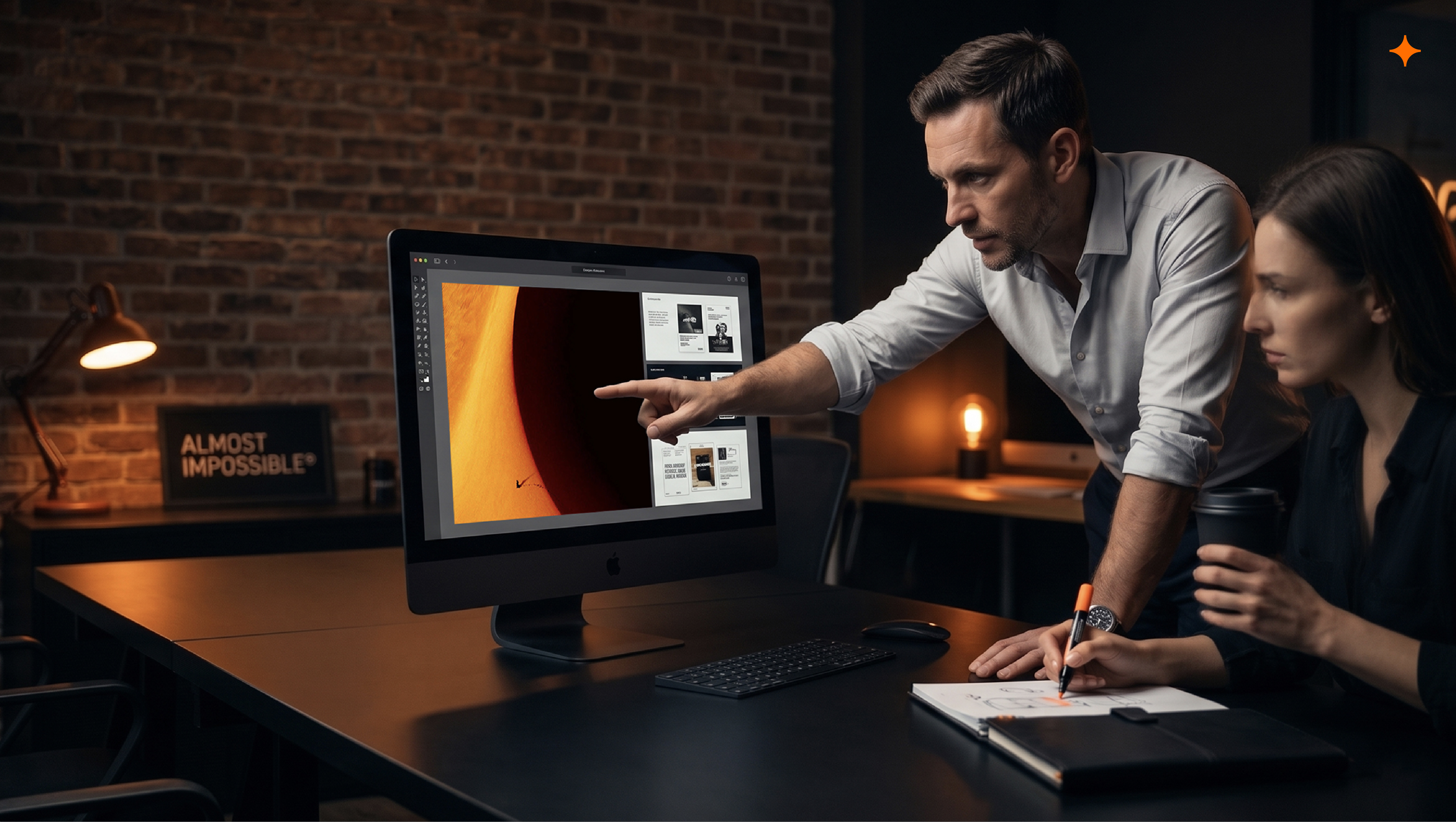
Almost Impossible (Dubai, UAE)
Founded in 2016, Almost Impossible has built a reputation for turning ambitious briefs into boundary-pushing brand experiences across MENA and EMEA. Their work spans branding, digital platforms, experiential marketing, and content creation.
- Expertise: Brand identity, experiential campaigns, product design and engineering, digital transformation
- Notable work: Bullet Train VR, Cards of Hope
- Strengths: Senior-led teams, cross-market activation, creative innovation
“The best agency relationships are built on shared ambition, not just shared budgets. When a team genuinely believes in what you are building, the work shows it.”
Note: We’re including ourselves for completeness and transparency, alongside other strong boutiques in the region.
Serviceplan Middle East (Dubai, UAE)
A boutique arm of a larger European network, Serviceplan operates with the independence and creative focus of a regional specialist while drawing on global strategic tools.
- Expertise: Brand strategy, integrated campaigns, data-driven creative
- Strengths: Strong regional client roster, bilingual creative teams
Flip (Dubai, UAE)
Flip is known for challenger brand thinking and fast-turnaround campaigns that resonate with younger Gulf audiences.
- Expertise: Social-first campaigns, influencer strategy, brand activation
- Strengths: Speed, cultural relevance, youth market fluency
Memac Ogilvy (Regional, multiple offices)
While part of a global network, Memac Ogilvy’s regional teams operate with significant creative autonomy and deep Arabic-language expertise.
- Expertise: Integrated communications, public sector campaigns, brand storytelling
- Strengths: Long-standing regional presence, government and enterprise experience
Boutiques thrive in localisation, crisis counsel, and influencer curation amid talent scarcity. That advantage is most visible when a campaign needs to feel native to a specific city, dialect, or cultural moment rather than broadly regional.
Comparing boutique vs. big agencies: What the data and leaders say
Wondering how boutiques stack up against the big networks in the Middle East market? Let’s break it down:
| Factor | Boutique agencies | Large network agencies |
|---|---|---|
| Flexibility | High, fast pivots | Low, approval layers |
| Local insight | Deep, embedded | Surface-level or outsourced |
| Scaling capacity | Limited | Strong |
| Service depth | Specialised | Broad |
| Innovation speed | Fast | Slower |
| Senior access | Direct | Often limited |
The Middle East advertising market is estimated at USD 8.18 billion in 2025, projected to reach USD 10.78 billion by 2031 at a 4.71% CAGR. Saudi Arabia alone accounts for USD 2.3 to 2.4 billion of that figure. That growth signals serious opportunity, but also serious competition for share of voice.
In that context, size is not always an advantage. When economic pressures hit, boutiques face cashflow risks but consistently outperform on resilience and cultural relevance. Large agencies can absorb financial shocks more easily, but they often struggle to adapt messaging quickly when market sentiment shifts.
Brand leaders who have worked with both types consistently say the same thing: when the brief requires genuine cultural resonance and creative courage, boutiques deliver. When the brief requires global media buying or multi-country rollout infrastructure, large networks have the edge.
Pro Tip: Look for boutique agencies with proven cross-market activation records across at least two Gulf Cooperation Council markets. That versatility signals both regional fluency and operational maturity beyond a single city.
Which agency type fits your brand’s needs best?
So, how should you weigh all these factors and pick the ideal partner for your company’s current challenge?
Start by identifying your brand’s top priorities in order:
- Reach: Do you need to cover multiple markets simultaneously, or go deep in one?
- Relevance: Is cultural authenticity the make-or-break factor for your campaign?
- Innovation: Does your brand need to create a category-defining experience or a new visual identity?
- Speed: How quickly do you need to move from brief to market?
Once you rank those four, the agency fit becomes clearer. Clients prioritise understanding vision over size, and boutiques consistently outperform in crisis counsel and localisation. That insight should anchor your decision.
Here is how different brand types typically map to agency fit:
| Brand type | Recommended agency fit | Primary reason |
|---|---|---|
| Regional startup | Boutique | Speed, cost efficiency, creative agility |
| Challenger brand | Boutique | Bold ideas, cultural sharpness |
| Established local brand | Boutique or hybrid | Deep market knowledge |
| Multinational entering region | Boutique for localisation layer | Cultural translation |
| Global brand, multi-market rollout | Large network | Infrastructure and scale |
A multinational entering Saudi Arabia, for example, often benefits most from pairing a global network for media buying with a boutique agency for creative and cultural adaptation. The two are not mutually exclusive.
Smaller teams also drive faster pivots. When a cultural moment emerges or a competitor makes a move, a boutique can respond in days rather than weeks. That speed is not just convenient. In a market as dynamic as the Gulf, it is a competitive advantage.
Why specialised agencies win in the Middle East’s evolving market
Conventional wisdom still defaults to big agencies as the safe choice. Bigger team, bigger budget, bigger accountability. But that logic breaks down in a market where cultural nuance is the primary driver of brand trust.
The Middle East rewards specificity. A campaign that resonates in Riyadh may fall flat in Dubai, and what works in Dubai may miss entirely in Beirut. That granularity requires people who understand the texture of each market, not just its demographics. Boutique agencies, built around specialist teams and direct client relationships, are structurally better suited to deliver that.
We have seen this play out repeatedly. The brands that build lasting equity in this region are not the ones with the largest agency retainers. They are the ones whose agency partners genuinely understand what they are trying to build and why. Vision alignment and creative courage matter more than headcount. As the market continues to grow toward that USD 10.78 billion projection, the brands that invest in specialised, culturally fluent partnerships will consistently outperform those chasing scale for its own sake.
Unleash your brand with a leading boutique agency
Ready to put these insights into action? Here’s a way to unlock real brand impact.
Almost Impossible has spent nearly a decade helping ambitious brands across MENA and EMEA create experiences that actually move people. From immersive activations like Bullet Train VR to purpose-driven campaigns like Cards of Hope, the work speaks to what happens when creative courage meets cultural intelligence. You can explore the full range of projects in the agency portfolio or browse featured clients to see the brands we have partnered with.
If your brand is ready to stop blending in and start building real presence in the Middle East, the team at Almost Impossible would love to hear what you are working on. Reach out for a creative consultation and let’s explore what is possible.
FAQs
What makes a boutique advertising agency different from a large agency?
Boutique agencies specialise in creative and branding services with direct leadership access, while large firms prioritise scale and a wide range of services across multiple disciplines.
Are boutique agencies more effective for local Middle Eastern campaigns?
Boutiques consistently excel at localisation, influencer curation, and adapting to cultural nuances, making them a strong fit for campaigns that need to feel native to a specific regional audience.
How big is the advertising market in the Middle East?
The Middle East advertising market is valued at USD 8.18 billion in 2025 and is projected to reach USD 10.78 billion by 2031, reflecting strong and sustained regional growth.
When does it make sense to choose a big agency over a boutique?
Large agencies suit multinationals that need end-to-end solutions and global media infrastructure, while boutiques are the stronger choice when vision and localisation are the primary drivers of campaign success.
Recommended
What's Next?

Start a Project
Have a challenging brief? We thrive on the impossible. Let's build something world-class together.
Get in touch
Join the Team
Obsessed with details? We're always looking for world-class designers and engineers.
View openingsFollow the Journey
See what we're building, reading, and learning. Connect with us on LinkedIn.
Connect on LinkedIn