
TL;DR: Agencies in the Middle East must adopt structured frameworks like Double Diamond and design thinking for innovation. Success requires leadership support, access to user research, cultural insights, and a culture that encourages risk-taking. Iterative processes, psychological safety, and regional adaptation are crucial for delivering memorable, impactful work.
A proven design process turns creativity from a spark into a repeatable system: discover, define, prototype, test, and refine.
Agencies across the Middle East are under real pressure. Clients expect breakthrough work, regional competition is intensifying, and the cost of inconsistent creative output is no longer just a missed brief: it’s lost revenue and damaged reputation. Many agencies default to linear, intuition-driven processes that worked five years ago but now produce predictable, forgettable results. This guide cuts through the noise. You’ll find field-tested frameworks like the Double Diamond, IDEO Design Thinking, and Frog’s Collective Action Toolkit, along with practical steps to build a repeatable innovation engine inside your agency.
Key Takeaways
| Point | Details |
|---|---|
| Structured frameworks matter | Proven models like Double Diamond and IDEO’s process help agencies consistently unlock creativity and innovation. |
| Local adaptation wins | Tailoring user research and iteration for Middle East markets enables standout, client-focused solutions. |
| Non-linear iteration works best | Continuous testing and feedback loops drive better outcomes than rigid, linear processes. |
| Culture drives results | Team mindset and leadership commitment are the foundation for making new processes succeed. |
Laying the groundwork: What innovative design requires
Before you redesign your agency’s creative process, you need the right conditions in place. Jumping straight to a new framework without addressing leadership buy-in, team structure, or access to user research is one of the most common false starts we see. The result is a process that looks good on a whiteboard but collapses under the pressure of real client work.
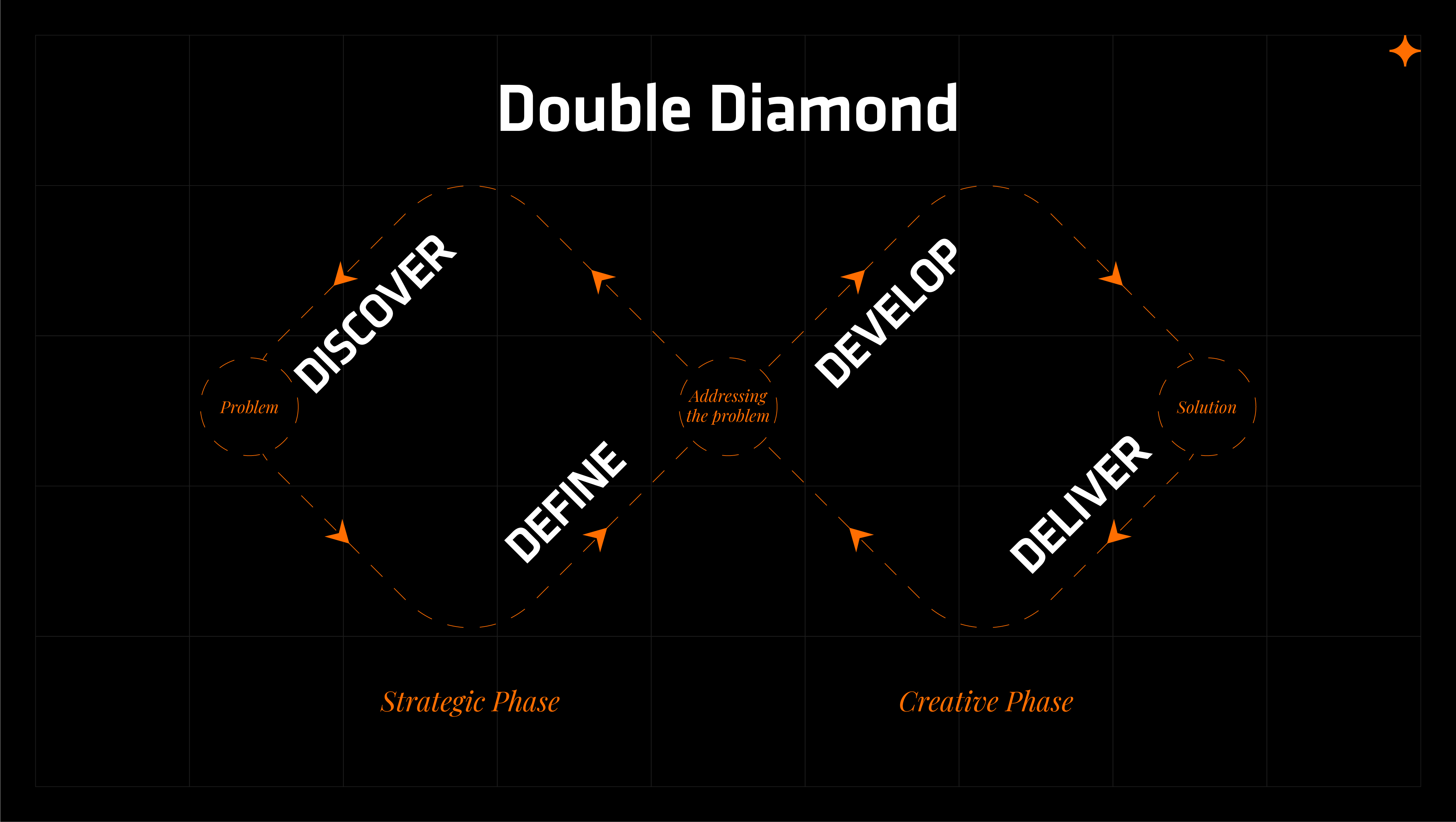
Innovation in an agency context means something specific. It’s not about wild ideas. It’s about structured risk-taking, empathy-driven research, and iterative cycles that allow your team to test assumptions before committing to a direction. Design thinking frames this well: the Double Diamond approach is a core design process used by innovative agencies, featuring four distinct phases that separate problem exploration from solution development.
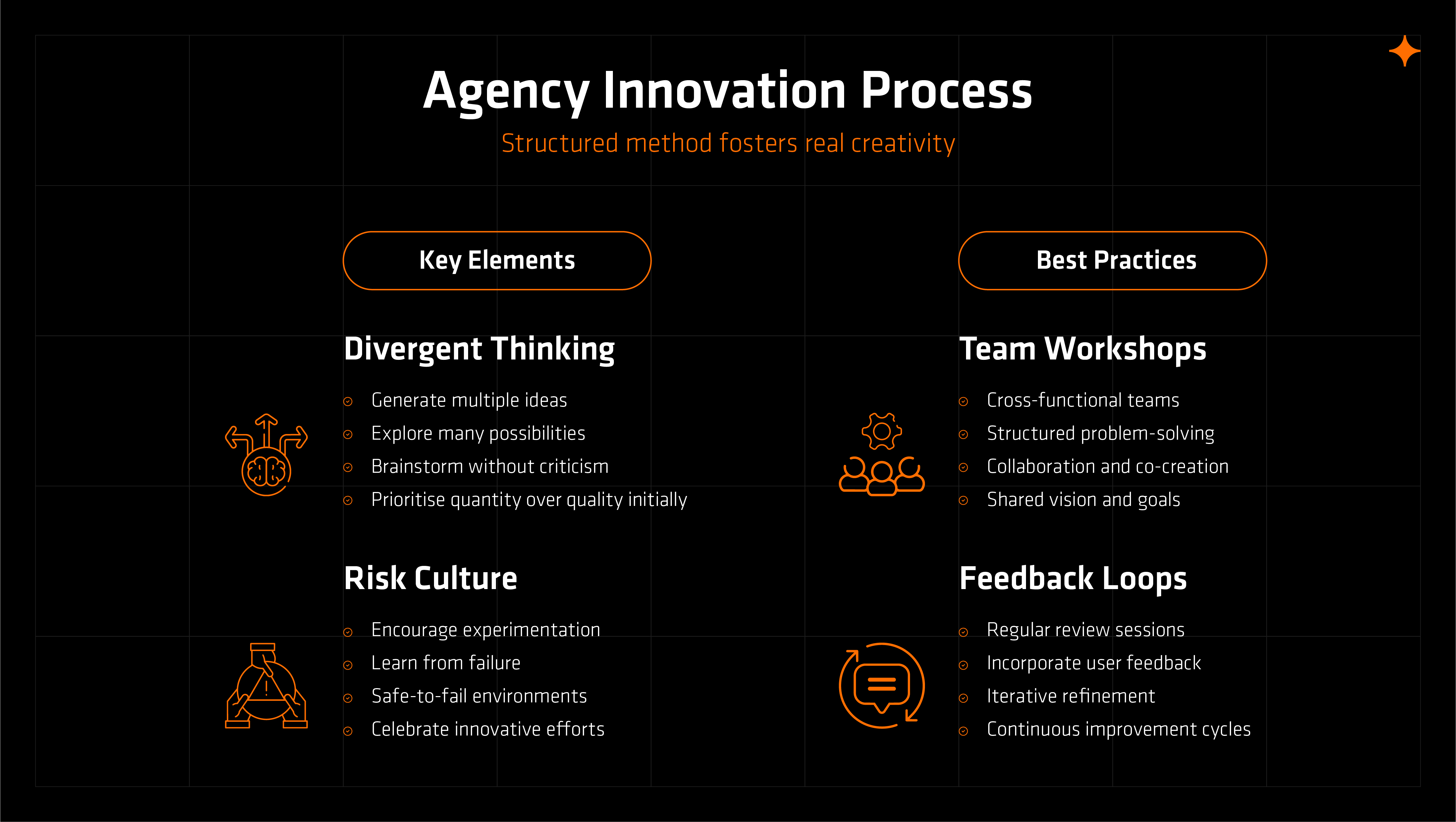
Here’s a quick overview of the essential tools and roles you need before launching a new process:
| Role | Responsibility | Key tool |
|---|---|---|
| Creative director | Process ownership and quality gates | Workshop facilitation guides |
| Strategist | User research and insight synthesis | Interview frameworks, journey maps |
| Designer | Concept development and prototyping | Figma, Miro, rapid prototyping kits |
| Client lead | Stakeholder alignment and feedback loops | Feedback templates, review cadences |
| Project manager | Timeline, sprint management | Agile boards, sprint trackers |
Beyond roles and tools, four prerequisites consistently separate agencies that innovate from those that imitate:
- Leadership buy-in: Process change fails without senior commitment to allocating time and protecting experimentation.
- Time allocation: Innovation requires dedicated cycles, not leftover hours between billable work.
- User research access: You cannot design for Middle Eastern consumers without direct access to their behaviours, values, and pain points.
- Local cultural insight: Regional nuance shapes everything from visual language to decision-making hierarchies. Generic global templates miss this entirely.
Divergent thinking, the ability to generate many possibilities before narrowing down, is a skill most teams need to practice deliberately. Agencies that skip this phase produce generic work because they converge on the first plausible idea rather than the best one. Our agency project examples show what happens when teams are given the space to explore broadly before committing.
Pro Tip: Schedule a cross-team workshop at the very start of any new process redesign. Mixing strategists, designers, and account managers in the same room surfaces assumptions early and builds shared ownership of the outcome.
Double Diamond: Structure for creative exploration
Once your team has the right mindset and tools, a structured framework becomes a genuine accelerator rather than a constraint. The Double Diamond model, developed by the UK Design Council, is one of the most effective structures for agencies because it makes the creative process visible and manageable.
The four phases work like this:
- Discover: Diverge widely. Conduct user interviews, observe behaviours, audit competitors, and gather raw insight without filtering. For Middle East markets, this means going beyond digital surveys and engaging communities directly.
- Define: Converge on the real problem. Synthesise your research into a clear problem statement. This is where most agencies rush, and where the most value is lost. Take the time to map pain points accurately.
- Develop: Diverge again. Generate multiple concepts, build rough prototypes, and test ideas quickly. Speed matters here, but so does variety. Avoid falling in love with the first concept.
- Deliver: Converge on the solution. Refine, test with real users, iterate based on feedback, and launch with confidence.
As modern Double Diamond design research confirms, the framework emphasises a clear separation between problem identification and solution development. That separation is what prevents agencies from solving the wrong problem beautifully.
“The biggest creative failures we’ve witnessed come not from bad ideas, but from teams that converged too early. Deep exploration is what separates memorable work from mediocre work.”
Pro Tip: Treat the Define phase as a full deliverable, not a transition step. A sharp, validated problem statement is worth more than three weeks of concept development built on a shaky foundation.
Compared to traditional linear processes common in the region, where briefing flows directly into conceptualisation and production, the structured design thinking model of Double Diamond adds deliberate friction. That friction is productive. It forces teams to question assumptions and builds client confidence through visible rigour.
Adapting IDEO and Frog approaches for Middle East client work
The Double Diamond gives you structure. IDEO and Frog give you methods to fill each phase with genuine creative intelligence. Both frameworks are internationally proven, but they require thoughtful adaptation for regional client realities.
IDEO’s design thinking process includes 7 clear steps emphasising empathy and iteration: define, research, ideate, prototype, choose, implement, and learn. Frog’s Collective Action Toolkit features six dynamic stages focused on community-level innovation: goals, context, ideas, build, test, and story.
| Stage | IDEO’s process | Frog CAT |
|---|---|---|
| 1 | Define the challenge | Set goals |
| 2 | Conduct research | Understand context |
| 3 | Ideate solutions | Generate ideas |
| 4 | Prototype concepts | Build and test |
| 5 | Choose direction | Test with communities |
| 6 | Implement and launch | Share the story |
| 7 | Learn and iterate | – |
The key difference is focus. IDEO centres on individual user journeys, making it ideal for brand experience and product design work. Frog’s approach centres on groups and communities, which is particularly valuable in Middle Eastern markets where collective identity, family structures, and community influence shape purchasing decisions far more than in Western contexts.
When to use each:
- Use IDEO’s process when your brief involves a specific user persona, a product experience, or a digital platform where individual behaviour drives outcomes.
- Use Frog CAT when the brief touches community engagement, social campaigns, or cultural programmes where group dynamics matter.
- Watch for this pitfall: Agencies unfamiliar with non-linear methods often revert to linear execution mid-process. Build checkpoints that force teams back into the framework.
- Benchmark consistently: A solid design thinking case study gives your team a reference point for what transformation actually looks like in practice.
You can see how the Frog Collective Action Toolkit in action translates into real creative output when applied with genuine cultural sensitivity and community focus.
Iterate, validate, integrate: Best practices for results
Even the best framework breaks down without disciplined iteration. The agencies that consistently deliver innovative work aren’t the ones with the most sophisticated process documents. They’re the ones that treat every project as a learning opportunity and build feedback into the work itself.
Start with a troubleshooting checklist before each major phase transition:
- Have we spoken to enough real users, or are we relying on assumptions?
- Is our problem statement specific enough to guide concept development?
- Have we tested at least two divergent directions before converging?
- Do we have client alignment on the criteria for a successful outcome?
- Are we measuring the right things at each stage?
Embedding iteration means more than running a single round of user testing. It means building feedback loops into your sprint structure, running pilot tests with smaller audience segments before full rollout, and making course corrections based on data rather than preference. Iterative and non-linear design processes consistently outperform linear ones because they surface problems while they’re still cheap to fix.
The evidence supports this approach. NTUC Income’s design thinking journey shows how agencies and brands that adopted cross-functional teams and iterative labs transformed both their products and their client relationships in measurable ways.
For agencies running Agile sprints, design thinking integrates cleanly through dual-track discovery: one track for ongoing user research and problem definition, another for active development and delivery. This prevents the common failure mode where development outpaces understanding.
Simple metrics to track process improvement:
- Time-to-prototype: How quickly can your team produce a testable concept from a brief?
- User feedback scores: Are real users responding positively to prototypes before production investment?
- Creative diversity ratio: How many distinct directions did your team explore before converging?
- Client revision cycles: Fewer late-stage revisions signal stronger upfront alignment and research.
Browse real innovation case studies to see how these principles translate into client outcomes across different industries and brief types.
Why true agency innovation starts with culture, not just process
Here’s the uncomfortable truth most process guides skip: frameworks don’t innovate. People do. We’ve seen agencies implement the Double Diamond, run IDEO workshops, and still produce uninspired work because the team didn’t feel safe enough to challenge a client’s brief or question a creative director’s first instinct.
Psychological safety, the belief that you can take creative risks without punishment, is the actual engine of innovation. Without it, even the most elegant framework becomes a checkbox exercise. Teams go through the motions of divergent thinking while privately converging on the safest option.
Cultural fit matters just as much as methodology. Agencies that import Western frameworks without adapting them to regional communication styles, decision-making norms, and client relationship dynamics often find the process creates friction rather than flow. Empathy and non-linear iteration must be prioritised alongside benchmarking global successes, not treated as secondary concerns.
Our experience working with brands across the Middle East confirms this: the agencies that achieve real creative transformation are those where leadership actively models experimentation, celebrates productive failure, and gives teams permission to push back. Process is the vehicle. Culture is the fuel. You can find agency transformation stories that reflect exactly this combination of rigorous process and genuine creative courage.
Transform your next project with an innovative design partner
Ready to turn knowledge into visible creative impact? At Almost Impossible, we don’t just apply these frameworks in theory. We’ve built our entire agency practice around the methods covered in this guide, adapting them for the specific demands of Middle Eastern brands and the global ambitions they carry.
From innovative VR experiences to full-scale brand transformations, our work reflects what happens when structured process meets genuine creative courage. If you’re a brand manager or marketing executive looking to elevate your agency’s output, explore our agency portfolio or reach out to discuss agency client partnerships that move the needle.
FAQs
Which design process framework is best for brand managers in the Middle East?
Double Diamond is the most reliable starting point because it prevents premature solutions and forces clarity before creative development. IDEO’s approach strengthens empathy and testing. The real advantage comes from adapting either framework to local context through research and fast iteration.
How do you measure ROI from a new agency design process?
Track what the process changes: cycle time, number of prototypes tested, fewer late-stage revisions, client approval confidence, and post-launch performance (engagement, conversion, retention). If the process is working, you’ll see less rework and better outcomes with the same team.
What is the biggest mistake agencies make when adopting design frameworks?
Jumping to solutions without deep empathy research. Premature convergence consistently produces generic creative because teams solve the first version of a problem rather than the real one.
How can an agency push past traditional, linear processes?
By embracing non-linear iteration, frequent prototyping, and cross-functional workshops, agencies create the conditions where genuine creative breakthroughs become repeatable rather than accidental.
Recommended
What's Next?

Start a Project
Have a challenging brief? We thrive on the impossible. Let's build something world-class together.
Get in touch
Join the Team
Obsessed with details? We're always looking for world-class designers and engineers.
View openingsFollow the Journey
See what we're building, reading, and learning. Connect with us on LinkedIn.
Connect on LinkedIn