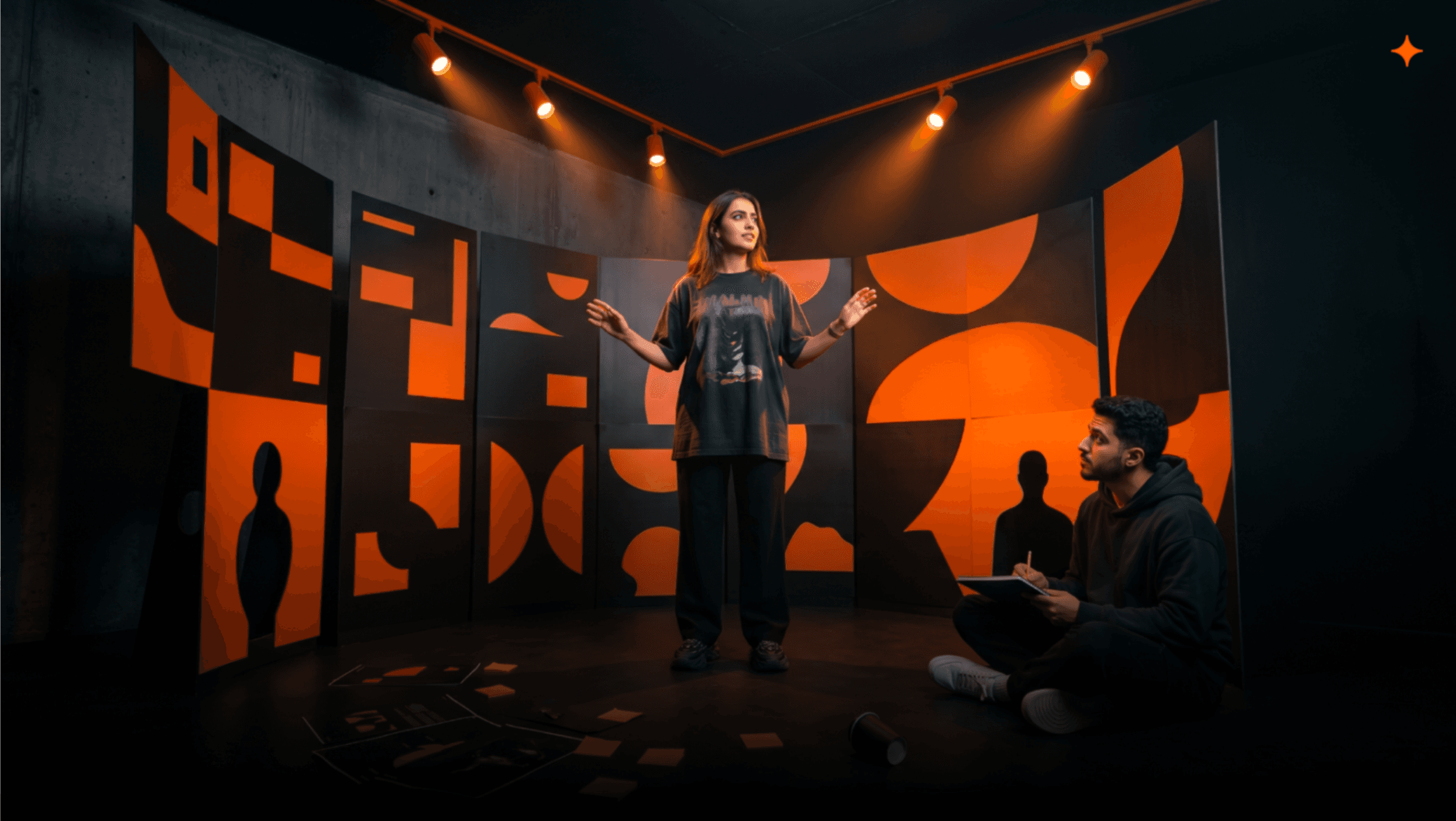
TL;DR: Genuine immersion relies on user belief, agency, and cultural relevance, not just technology. Well-designed immersive experiences can boost brand perception by 25% and increase conversions above 11%. Middle East brands should focus on cultural authenticity, meaningful interaction, accessibility, and measuring pipeline signals.
Immersive design works when people stop watching and start participating.
Forget the assumption that immersive design means strapping a headset to your customer and calling it innovation. Real immersion is far more nuanced, and far more powerful, than any single piece of hardware. Brands across the Middle East are increasingly investing in experiential marketing, yet many confuse spectacle with substance. The distinction matters enormously, because poorly executed immersion wastes budget and alienates audiences, while genuinely immersive design can boost brand perception by 25% and drive conversion rates above 11%. This article cuts through the noise, giving you a clear framework for understanding, building, and measuring immersive design that actually works.
Key Takeaways
| Point | Details |
|---|---|
| True immersion explained | Immersive design is about creating believable experiences, not just using new technology. |
| ROI you can measure | Immersive campaigns deliver proven lifts in brand perception and conversion rates. |
| Risks and best practice | Avoid sensory overload and accessibility pitfalls by focusing on user comfort and interaction. |
| Local cultural relevance | Middle East brands succeed most by tailoring immersive experiences to local stories and context. |
| People first, tech second | Lasting connections come from putting audience needs above chasing the latest tech trends. |
Defining immersive design: beyond the buzzword
The word “immersive” has been stretched so thin that it risks meaning nothing at all. Pop it into a campaign brief and it signals ambition. Use it in a pitch deck and it sounds contemporary. But without a precise understanding of what immersion actually requires, you are likely building something that looks impressive in a press release and disappoints in practice.
At its core, immersive design is about creating an experience in which the participant genuinely believes they are present within a constructed world or narrative, and feels they have real agency within it. That second part is critical. Agency, the sense that your choices and actions shape the experience, is what separates genuine immersion from passive spectatorship. A beautifully rendered LED installation is stunning. It is not necessarily immersive in the truest sense.
“Immersion is subjective, defined by user belief and agency rather than technology alone. Coherence matters more than realism, and passive presence can suffice without active participation.” Immersive—as buzzword or essential?
This distinction reshapes how you should brief your team and evaluate your partners. An experience that uses relatively modest technology but builds a coherent, believable world around the user can outperform a multi-million-dirham VR installation that feels disjointed or irrelevant. The key variables are:
- Coherence: Does every element, visual, audio, spatial, tactile, support the same narrative?
- Agency: Can the user make meaningful choices that affect their journey?
- Believability: Does the world feel consistent enough that the user stops questioning it?
- Cultural relevance: For Middle East audiences, does the experience speak to their context, values, and heritage?
That last point deserves particular emphasis. Importing a Western immersive campaign wholesale into a Dubai or Riyadh context often produces technically sophisticated but emotionally hollow experiences. Meaningful, culturally resonant design always outperforms pure technology when it comes to lasting brand recall. This is precisely why strategic agency collaboration that understands local culture is not a luxury but a requirement.
Core methodologies in immersive design
Having defined immersive design, let us explore the methods that underpin successful immersive marketing projects. The practice draws from a rich toolkit, and knowing which instruments to reach for, and when, separates experienced practitioners from enthusiastic amateurs.
The primary methodologies, as established in professional practice, include VR/AR environments, interactive 3D models, and spatial audio, combined with motion calibration to prevent user discomfort, and iterative user evaluation through presence questionnaires and physiological monitoring.
| Methodology | Best application | Risk if misused |
|---|---|---|
| Virtual reality (VR) | Product launches, heritage experiences | Motion sickness, high cost |
| Augmented reality (AR) | Retail, events, outdoor activation | Poor lighting ruins overlays |
| Spatial audio | Brand storytelling, retail environments | Overload if poorly mixed |
| Interactive 3D models | Architecture, real estate, exhibition | Slow load times on mobile |
| Presence questionnaires | Post-experience user research | Self-report bias |
| Physiological monitoring | Deep UX research phases | Resource intensive |
Each method has a role, but they work best in combination. Spatial audio, for example, is chronically underused in Middle East brand activations. Research consistently shows that sound shapes perception of space more powerfully than visuals alone. A retail environment with directional audio that draws customers towards featured products, or a brand experience that uses sound to signal transitions between narrative chapters, creates a depth that purely visual design cannot replicate.
Motion calibration is another non-negotiable. Any experience involving movement, whether real physical movement or simulated motion in a headset, must be tested rigorously across different user profiles. Age, prior VR exposure, and even diet on the day can affect susceptibility to discomfort. Our work on Cards of Hope demonstrates how careful iteration, not just creative ambition, produces experiences that users actually want to revisit.
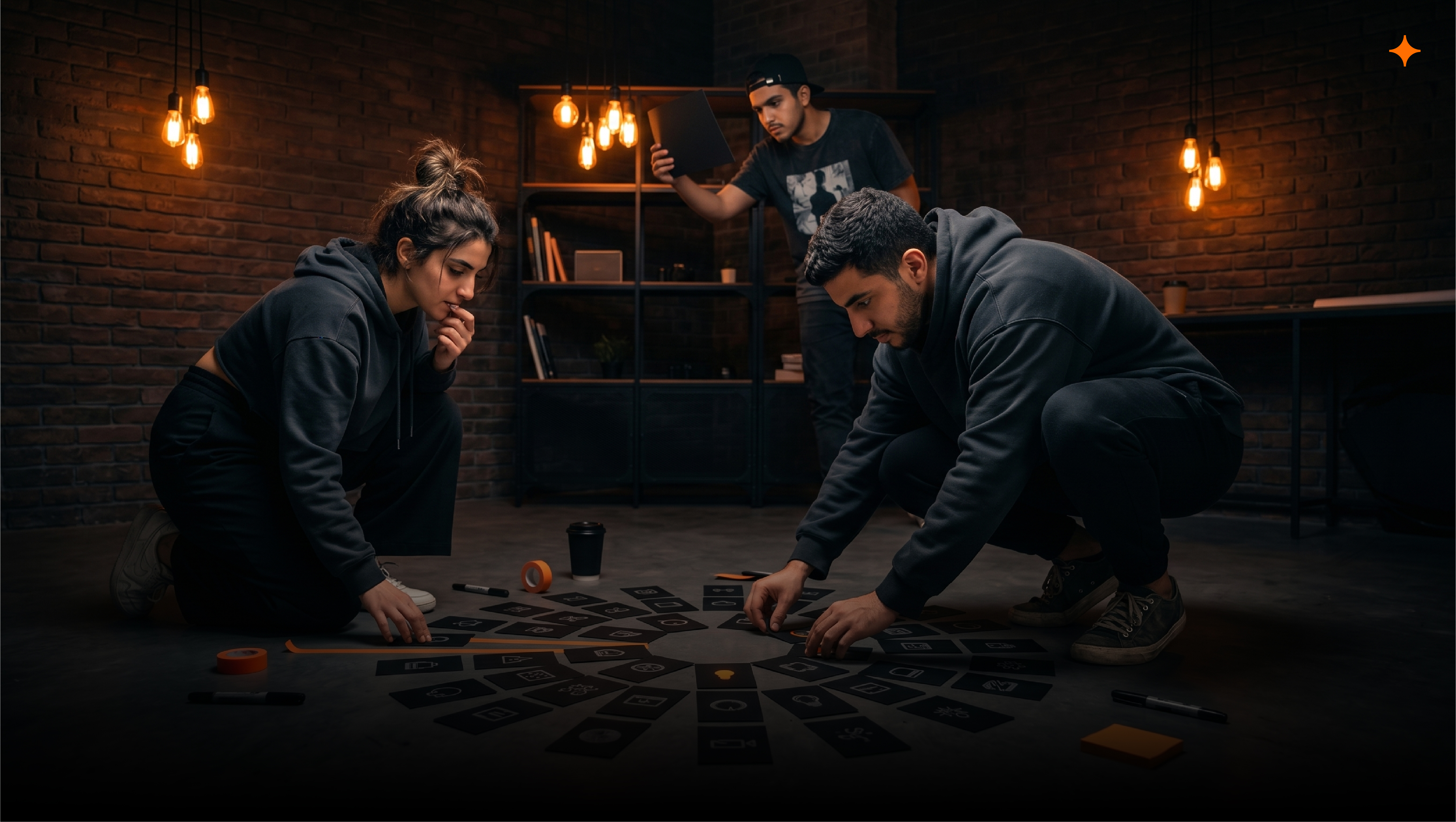
Pro Tip: Before committing to a full production budget, build a low-fidelity prototype of your core interactive loop and test it with 10 to 15 people from your actual target audience. The feedback you collect in that session will save you significant time and money in post-production revisions.
The iterative process also includes crisis management in design, preparing for technical failures and accessibility gaps before they occur in a live environment. The best campaigns have contingency plans that are invisible to the audience but essential to smooth delivery.
Proving the value: ROI and evidence from immersive campaigns
Understanding the methodology is important, but the real question is: does immersive design work? Here is the data, and the case studies behind it.
The empirical evidence is compelling. Experiential campaigns deliver a 25% increase in positive brand perception, an 11% conversion rate, and revenue figures exceeding $500,000 per event. Retail commands a 26% share of the immersive marketing market, making it the single largest category. Readers exposed to immersive publishing content complete twice as many books as those using traditional formats.
These are not hypothetical projections. They are benchmarks drawn from live campaigns.
Top four ROI indicators for immersive campaigns:
- Conversion rate above baseline: Compare the percentage of attendees or users who take a desired action, purchase, sign-up, or download, against equivalent non-immersive campaigns.
- Brand perception uplift: Measure pre and post-experience sentiment through structured surveys, not just social media mentions.
- Dwell time: Users who spend longer within an immersive environment consistently show higher recall and purchase intent.
- Repeat engagement: A genuinely effective experience drives return visits, both physically and digitally, which signals authentic value rather than novelty.
| Campaign type | Average conversion rate | Brand perception uplift |
|---|---|---|
| Traditional digital campaign | 2 to 4% | 5 to 8% |
| Experiential/immersive campaign | 11% | 25% |
| Hybrid (digital + physical) | 7 to 9% | 14 to 18% |
The numbers favour immersive investment, but only when the experience is properly designed and measured. Vanity metrics, impressions, likes, and raw footfall, tell you almost nothing about business impact. To understand measuring marketing effectiveness properly, you need to connect experience data to pipeline signals: enquiries, qualified leads, and sales.
Our Bullet Train VR campaign is a strong example of this evidence-led approach. Rather than optimising for social media shareability alone, the campaign was built around a specific audience journey with defined conversion goals. The result was measurable and commercially meaningful, not just visually arresting. You can explore the broader pattern across our agency clients to see how this translates across industries.
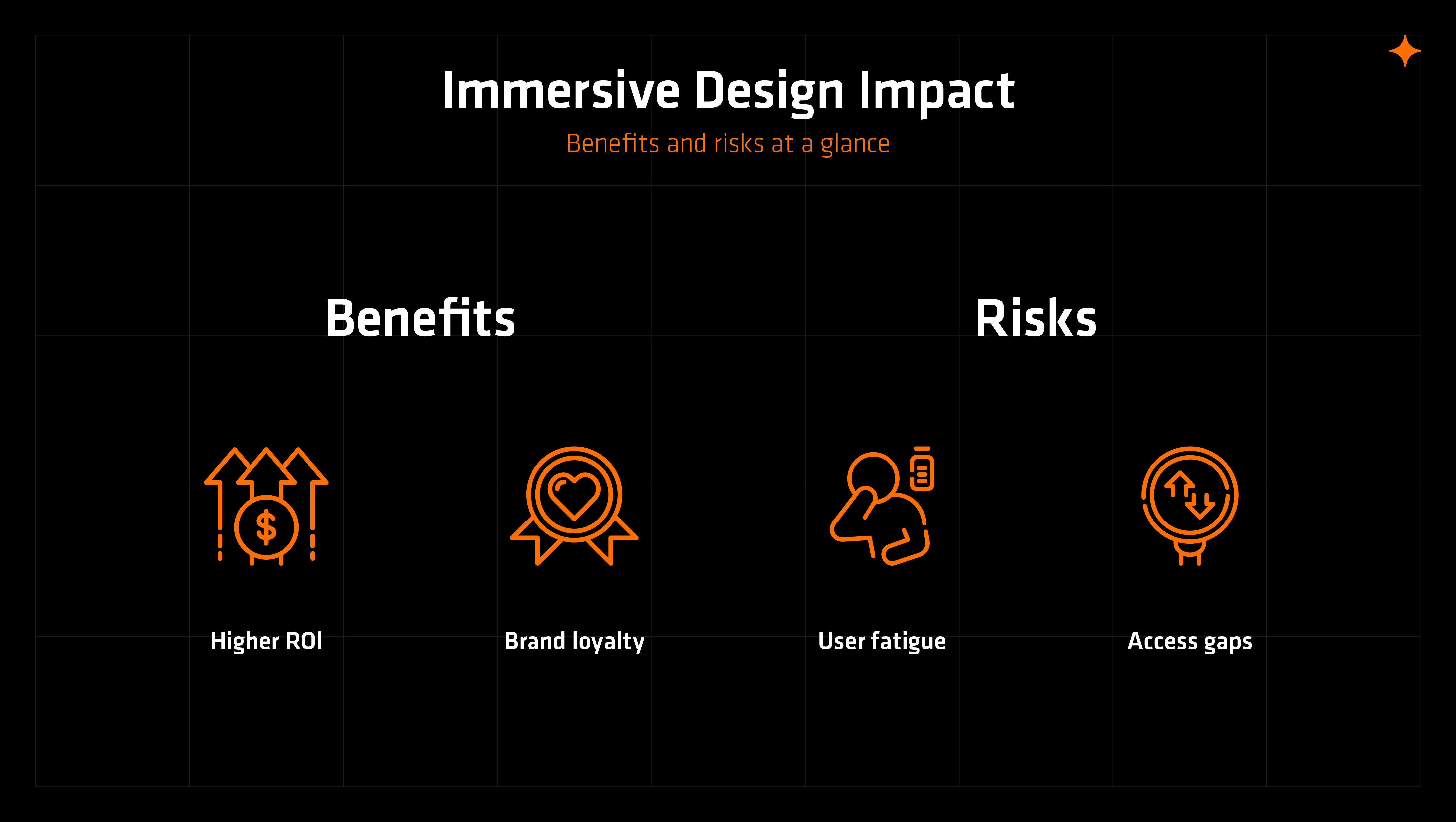
Risks, accessibility challenges, and what to avoid
While the potential is vast, immersive design is not without its risks. Every brand and marketer entering this space should understand where campaigns fail, and why.
The most common technical failure is motion sickness from poor calibration, followed by cognitive overload and accessibility failures that exclude large segments of the intended audience. Over-reliance on visuals without genuine interaction reduces participants to passive viewers, which produces low repeat visit rates and weak brand recall.
Here are the pitfalls that most frequently derail immersive campaigns:
- Prioritising visual spectacle over interaction: A stunning projection-mapped room is beautiful. If visitors cannot engage with it beyond looking, the experience ends quickly and leaves little emotional residue.
- Ignoring accessibility: Campaigns built exclusively around VR headsets exclude users with vestibular disorders, visual impairments, or physical limitations. This is both an ethical failure and a commercial one.
- Underestimating dwell time management: If an immersive experience takes 20 minutes per user but you have 500 visitors, you have a queuing crisis, not an engagement triumph.
- Launching without real-user testing: Internal team testing is not sufficient. Your team knows what the experience is supposed to do. Real users encounter it fresh, and they reveal failure points that familiarity hides.
- Neglecting the exit experience: The final moments of an immersive experience shape recall more powerfully than the opening. Many campaigns invest heavily in the entry and neglect the transition back to reality, losing the emotional crescendo.
Pro Tip: For every immersive project, assign a dedicated accessibility review at prototype stage, not at the final production phase. Retrofitting accessibility is expensive and often produces compromised results. Building it in from the start is both more effective and more cost-efficient.
Managing user comfort in VR environments requires sustained attention to frame rates, field of view, and locomotion design. These are technical specifics, but they translate directly into whether your audience remembers the brand or the nausea.
Making immersive design work for Middle East brands
With pitfalls addressed, how can Middle East brands use immersive design most effectively? Here is a practical framework built for this specific market.
The opportunity in the region is significant. AR and VR for culturally resonant experiences, such as heritage tours and traditional market recreations, represent genuine white space in a market that often defaults to technology for technology’s sake. The key is multi-sensory restraint, meaning you should deploy sensory layers with purpose, not abundance, and measure pipeline signals like conversions over raw impression counts.
A four-step framework for Middle East immersive campaigns:
- Ground the concept in cultural context: Start with a specific story, tradition, or community insight that is native to your target audience. This is not tokenism. It is the difference between an experience that feels made for the audience and one that feels adapted for them.
- Prioritise meaningful interaction over passive wonder: Design at least two moments within any experience where the user makes a genuine choice. This activates agency and dramatically increases emotional investment.
- Build in accessibility from day one: Ensure the experience works across age groups, physical abilities, and technology literacy levels. In markets where multigenerational family groups attend events together, this is commercially essential.
- Measure conversion signals, not impressions: Define your success metrics before production begins. Agree on what a conversion looks like, whether that is a product trial, a data capture, or a sales enquiry, and build the measurement infrastructure into the experience itself.
“Immersive marketing in the Middle East is most effective when it balances technological ambition with cultural authenticity and measures pipeline signals rather than impressions.”
Applying these principles consistently is how brands move from novelty to genuine competitive advantage. Our work on brand success in the UAE reflects this philosophy at every stage, from brief to deployment to post-campaign analysis.
Why true immersion means putting people, not tech, first
Here is the uncomfortable truth that most technology vendors and even many creative agencies prefer you did not examine too closely: the technology is the least important part of any immersive experience.
This is not contrarianism. It is a pattern that emerges repeatedly across successful and failed campaigns. The failures almost always begin with a technology choice, “we’re going to do a VR activation,” and then retrofit the audience experience around that choice. The successes almost always begin with a human insight, “our audience feels disconnected from our brand’s heritage,” and then find the appropriate medium to bridge that gap.
The critique of immersion as a design philosophy is worth taking seriously. Some argue that the pursuit of immersion prioritises realism over genuine emotional resonance, producing experiences that impress briefly but fail to create lasting behavioural change. VR simulations, for example, can trigger short-term emotional empathy but frequently fail to translate that empathy into sustained action because the content is shallow and the sensory experience is overwhelming.
The antidote is not less technology. It is better storytelling, more rigorous user research, and a willingness to iterate based on what users actually feel rather than what the production team intended them to feel. An experience that moves someone to tears because it connects to something real in their life will always outperform a technically flawless experience that leaves them admiring the production values.
This is why we approach every project in our immersive agency portfolio with the same starting question: what does this audience need to feel, and what is the minimum viable technology required to create that feeling? The answers are often simpler, and more powerful, than the brief initially suggests.
Ready to craft your brand’s next immersive experience?
This people-first approach is core to our philosophy and it is how we help clients achieve memorable, measurable results.
At Almost Impossible, we have been designing boundary-pushing brand experiences since 2016, from VR campaigns that set new benchmarks for audience engagement to sustainable design activations that blend cultural resonance with commercial impact. Every project begins with the human insight, not the technology budget. If you are a brand or marketing professional in the Middle East ready to move beyond surface-level activation and build experiences that genuinely convert, explore our client case studies and discover how we turn ambitious briefs into measurable reality.
FAQs
What is the main difference between immersive design and traditional digital design?
Immersive design creates interactive, believable experiences that prioritise user agency and genuine presence, while traditional digital design focuses primarily on visual communication and information delivery. Immersion is defined by user belief and agency, not by the sophistication of the technology involved.
How does immersive design impact marketing ROI?
Immersive campaigns consistently outperform traditional formats, with experiential campaigns delivering a 25% uplift in positive brand perception and an 11% conversion rate, compared to 2 to 4% for standard digital campaigns.
What are common pitfalls to avoid in immersive design?
Motion sickness, cognitive overload, and accessibility failures are the most frequent technical pitfalls, while over-reliance on visual spectacle without meaningful interaction produces passive experiences with low repeat visit rates.
How can Middle East brands ensure immersive design resonates locally?
Integrate authentic local cultural narratives into the core concept from the outset, then leverage AR/VR for culturally resonant experiences with multi-sensory restraint, measuring success through conversion signals rather than impression volumes.
Recommended
What's Next?

Start a Project
Have a challenging brief? We thrive on the impossible. Let's build something world-class together.
Get in touch
Join the Team
Obsessed with details? We're always looking for world-class designers and engineers.
View openingsFollow the Journey
See what we're building, reading, and learning. Connect with us on LinkedIn.
Connect on LinkedIn